
Marvel Cosmic Invasion developer Tribute Games is aptly named. Rather than try to push old-school genres forward or offer a meta take on classic game styles, the developer seems keen to present the best possible homages to games of yore.
Like its previous arcade-style beat-’em up, Teenage Mutant Ninja Turtles: Shredder’s Revenge, Marvel Cosmic Invasion appeals to what lured in arcade visitors during the 1990s: memorable characters, gorgeously animated sprites, and screen-filling spectacle. Marvel Cosmic Invasion’ gameplay isn’t groundbreaking; it plays much like old Capcom and Konami games, and borrows a little influence from other genres. There’s some Capcom Marvel fighting-game influence here, in terms of character moves and color palettes. But wild innovation or evolution isn’t really the point of Marvel Cosmic Invasion. Like its arcade ancestors, it is a simple, easy-to-pick-up, enjoyable-to-replay action game — ideally played cooperatively.
While the gameplay of Marvel Cosmic Invasion is familiar, Tribute Games has one-upped Shredder’s Revenge in one regard: the playable roster. Cosmic Invasion features an impressive 15 characters, ranging from iconic (Captain America, Iron Man, Black Panther) to deeper cuts (Beta Ray Bill, Cosmic Ghost Rider, Phyla-Vell). And there is tangible variety among the cast. A character like She-Hulk plays like more of a grappler, while Rocket Raccoon fills a trickster, gadget-focused role. Wolverine and Captain America feel almost ripped from Konami and Data East’s early Marvel brawlers.
Each hero has a standard set of moves (punches, dashes, blocks/dodges) and unique moves (projectiles, charge attacks), some of which are governed by cooldowns. Then there are the more dynamic and deadly special moves, big splashy attacks that wipe out multiple enemies at once — the kind that used to eat your character’s health in arcade games that wanted to eat all of your quarters.
Marvel Cosmic Invasion’ roster feels surprisingly diverse in how each hero plays. A character like Phyla-Vell or Silver Surfer can feel like a rushdown monster, while Venom and Rocket play much more strategically. Across the game’s story campaign, a roughly four-hour yarn in which you’re encouraged to play all the characters, I found myself vibing with some heroes over others. Captain America felt solid and reliable, while She-Hulk was a little harder to find a groove with, personally.
Where things get more interesting is in how characters complement each other. You’ll always take two heroes into battle and can swap between them at any time. But how you swap in your teammate varies. You can summon them to free you from an enemy’s grapple, or bring them in to chain a combo together or pair your super moves for a massive, screen-clearing explosion of super powers.
There’s a light progression system in Marvel Cosmic Invasion, which is largely based on time spent playing with them. You’ll level up heroes to unlock extra hit points and focus (a meter for your super move), and to unlock passive abilities and extra color palettes. These additions don’t feel all that substantial, but the extra perks can sometimes make a difference in challenging boss fights. I did manage to die a couple of times against boss-turned-playable hero Venom, and the extra HP probably did help me edge out a win.
Where Marvel Cosmic Invasion really excels is in its visuals and sense of style. The game’s art style draws from the ‘80s and ‘90s era of Marvel comics, action figures, and video games, with bright, bold colors and classic costumes. Backgrounds are teeming with life and detail, giving each biome and level a unique feel. And sometimes level backgrounds are truly dynamic. Without spoiling anything, giant characters like Master Mold and Galactus appear in certain levels and contribute to the action.
Marvel Cosmic Invasion’ campaign serves as a tour of the wider Marvel universe, with locations ranging from New York City to the Savage Land to Kree space. Just as the playable roster highlights some of Marvel’s most popular heroes, the campaign is a who’s who of Marvel’s big bads. You’ll have memorable boss fights against the likes of MODOK, Thanos, Knull, Hela, and even corrupted, Annihilus-controlled versions of some good guys. Along the way, you’ll fight a variety of common grunts: Sentinels, AIM flunkies, and Annihilus’ bug army. There’s definitely some interesting variations among the fodder, but others feel a little too repetitive.
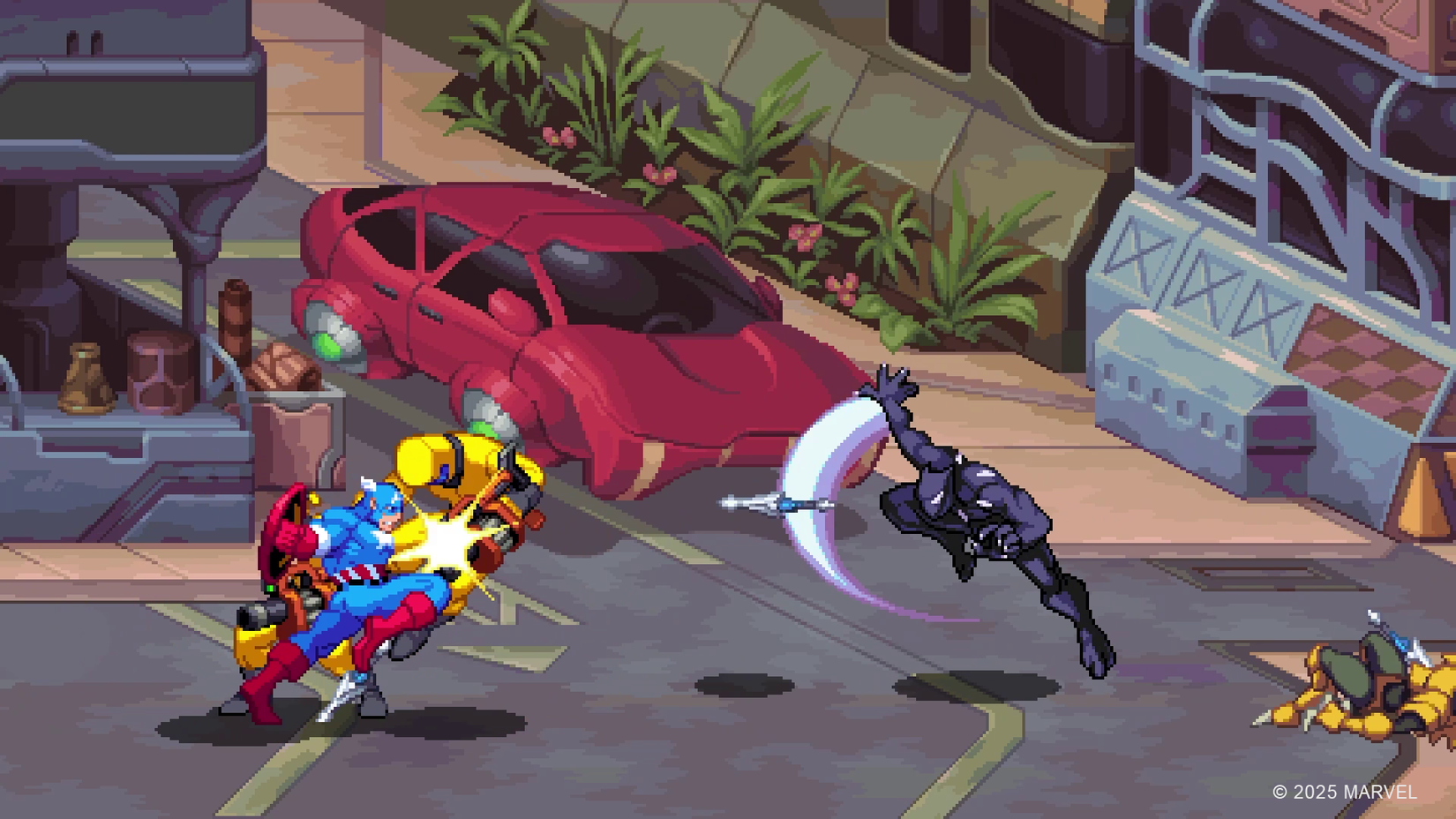
Outside of the campaign — which can be played in drop-in, drop-out online co-op across platforms, by the way — there is an arcade mode for playing specific levels and a long list of things (music, data files, color palettes) to unlock. And there are level-specific and hero-specific challenges to complete, ostensibly offering some replay value if you whiffed those tasks in your initial playthrough.
Probably the best way to play Marvel Cosmic Invasion is with a friend nearby, offering a window into the way these games used to be played decades ago: standing side-by-side at an arcade cabinet. Marvel Cosmic Invasion is perfectly fine to play solo, especially if you’re a fan of a certain Marvel age and enjoy things like She-Hulk breaking the fourth wall. But if you’re hoping for something that radically reinvents the beat-’em-up genre, you better look elsewhere. This is a beautiful, tightly playing, and loving tribute — ’nuff said.
Marvel Cosmic Invasion was released on Dec. 1 on Nintendo Switch, Nintendo Switch 2, PlayStation 4, PlayStation 5, Windows PC via Steam, and Xbox Series X. The game was reviewed on PS5 and Switch 2 using a pre-release download code provided by Dotemu. You can find additional information about Polygon’s ethics policy here.