
When the teaser for “Chrome Alone 2: Lost in New Jersey,” a new short film starring the Teenage Mutant Ninja Turtles, was released, an early complaint on the internet was a brief moment where tech-savvy Donatello consults with ChatGPT on what to get father-figure Master Splinter for Christmas. Cries of character assassination that the super smart Donnie would have to ask an AI algorithm for advice could be found all over Twitter.
As it turns out, Donnie’s flirtation with ChatGPT isn’t just a throwaway; it’s the whole plot of the delightful short, which pits the Turtles against Chrome Dome (voiced by Zach Woods), an AI menace using generative AI to rip off the Turtles’ likeness and sell ripoff toy versions of them for profit. Like a lot of “Teenage Mutant Ninja Turtles” media, the short has its tongue firmly planted in cheek, but it also sends a strong message that AI isn’t capable of what human creativity can manage.
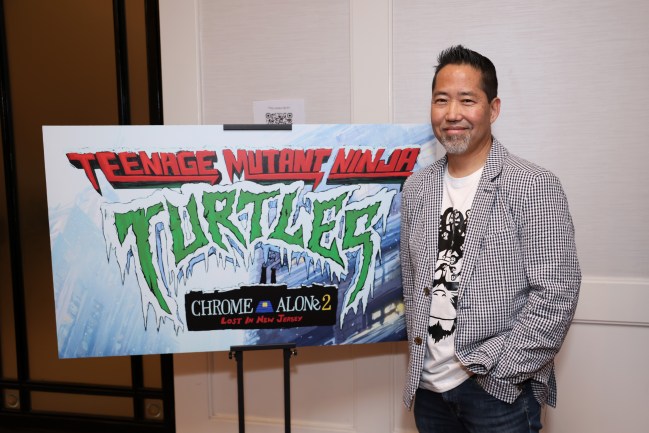
“Chrome Alone 2,” which will play in theaters before screenings of “The SpongeBob Movie: Search for SquarePants” later this month, is the directorial debut of animator Kent Seki, who served as the head of cinematography on “Mutant Mayhem,” the acclaimed 2023 film that introduced this era of TMNT. Seki, a longtime fan of the characters who collected their comics as a kid, said he initially joined the first film Ramsey Naito, former head of Nickelodeon Animation, connected him with the director Jeff Rowe. Seki had met Naito when he worked on “Boss Baby” in 2017, and told her he wanted to eventually direct; she kept that in mind, and offered him the chance to take on the short soon after “Mutant Mayhem” production wrapped.
“I’ve been trying to direct since 2007,” Seki told IndieWire in an interview. “This short film came up, and she found a place for me on it as a director. And it really was through her goodwill and her belief in me that this all happened.”
Below, Seki talks with IndieWire about making the short, tackling the topic of AI through “TMNT,” and how films like “Uncut Gems” and “Panic Room” influenced his directing process.
The following interview has been edited for length and clarity.
IndieWire: This film explores the intersection of generative artificial intelligence and art. Why did you want to tackle the subject, which is obviously very topical right now, through the turtles?
Seki: For the last three to four years, we’ve been hearing and seeing the rise of generative AI, like it’s all around us. And for anyone that works in a creative industry, it creates a lot of anxiety about what this means for us? You hear things that you’re going to be replaced. You see these tools and they are impressive, at the same time, you see some of their limitations and their downfalls. And there’s a lot of hyperbole about what it’s going to do, so it ended up being a case that doing a film around AI allowed us to channel and funnel all of that anxiety into the film itself. It ended up being extremely productive for us, when we really decided to focus on AI, it informed all the art styles that we used in it. It informed the writing. I was surprised when the teaser came out, how much people agreed with the sentiment. It was an interesting moment to watch something you made a year ago be more relevant now than it was when we made it. We were afraid, actually, a year ago, we were like, “well, this doesn’t come out for a year. Maybe this discussion will be over by then.” If anything, it’s become even more topical.
IndieWire: Can you explain a little more what you mean about how AI informed the visuals and writing?
Seki: If you look at the live action commercial, for example, even the live-action kids have extra fingers. The notion was that everything’s off by a little bit, there was this feeling that we wanted to be everything to be a little bit odd, right? It has this gauze of nostalgia over it that like a retro commercial. We went through and treated the footage to make it look like it was shot off of a videotape. We did the little things that make the turtles more commercial in the sense of their giant muscles and crazy veins sticking out of them.
In the backstory Chrome Dome tells the turtles, the writing is a combination of several franchises. There’s a moment in which Chrome Dome encounters a magical being that’s a combination of Handsome Squidward, Thanos, the Navi from “Avatar,” and Dr. Manhattan, all made into one character. Even in the scoring, I went to our composer Disasterpeace and said “Imagine this is a piece of diegetic music that the turtles are hearing, that everyone in the movie can actually hear, and that Chrome Dome has created because he believes his own backstory.” The fundamental thing about a liar, is they believe their own lie, and he would have listened to all these amazing Hans Zimmer scores and then made his own version like that, but worse. He went to town with that and made this epic score that’s kind of overblown. In the sound design from Mark Mangini, he went through and found sound effects from the actual IP that we were riffing on and parodying and peppered that in. Every department was adding to that storytelling and using AI as the punching bag for our feelings about it.
IndieWire: The commercial you mentioned nods back to the franchise’s heyday in the ’80s and ’90s. How did you film it?
Seki: We originally had them going into the store and handling the toys themselves, but story artist John Jackson said, “you could have a commercial in the window that we would watch.” And I thought that’s a great idea, but we can’t afford to do that, and we couldn’t afford to do that in CG. But we hired this great company, the Brothers Chaps in Atlanta, and basically we contracted them out to make it. We had to be hands off on it. And they got the prototype toys from the toy company and made this commercial. That’s one of the things that we wanted to sort draw on, was this idea of using nostalgia as a weapon to draw in parents to buy toys. The turtles have a long tradition of toys, right? That’s a lot of people come to that this franchise through the toys, and to use it as a meta narrative, to say something about AI at the same time the franchise itself and the corporatization of an indie comic, we thought was a very clever way of, sort of taking making a nod to all of these different things that the film has in it.
IndieWire: The short begins with Donnie asking ChatGPT a question about gifts to get Splinter. By the end, after fighting Chrome Dome, he deletes the app. Why did that make sense for his character.
Seki: I know it was controversial that Donnie used ChatGPT [Laughs]. I think what it comes down to is the turtles created by Jeff Rowe and Seth Rogen are authentically teenage. Teenagers are naturally curious, and they experiment with all these things. So it made sense that in their moment in their lives, that would be something that they would experiment with. It was in contrast to the ceramic mug that Mikey made. Do you make something by hand, this lovingly crafted, the ugly mug, or do you rely on this technology to tell you what to give your parent for Christmas? That’s the contrast. If you’re a parent, you’ve received that mug in some shape or form and loved it, even though it has many flaws. And sometimes I would say the flaws make it lovable. Or do you go with the answer that technology gives you, right, and which is sort of the easy answer, and I think that’s the contrast we’re drawing there. Having Donnie learned that lesson throughout the short doesn’t mean he rejects technology, but that he can leave with this healthy skepticism of technology.
IndieWire: How did you think of making the short visually distinct from “Mutant Mayhem?”
Seki: That was driven by our Art Director, Garrett Lee, who was really interested in sort of finding a new a new look in it that expanded upon what we did in Mutant Mayhem. One thing we did was we shot with two frames of a focal length longer to try and stack the frame, stack the image with as much New York as possible, so that the Turtles, who ended Mutant Mayhem being accepted into society, would now be part of society. We took a lot of inspiration from the Safdie Brothers and “Uncut Gems,” if you can believe it for that opening bit. We looked to it as something that we wanted to do to make it feel more New York, because the Safdies know how to shoot New York. They are amazing at it. We also drew upon David Fincher’s “Panic Room” for when they are breaking into the toy factory, And then for the end fight, we looked at James Cameron’s “Avatar.” So we had all these cinematic touchstones that we sort of looked at for inspiration, to help influence how we were making the film.
IndieWire: The title is a reference to “Home Alone.” Did that come up as a reference during production?
Seki: I think that the physical comedy definitely has roots in “Home Alone.” There was a moment in which we were trying to figure out what the title of the movie should be. We were in a lighting review. And there was concern if we want to have Christmas in the title, and we’re like, “I don’t know if that feels right for this” but it should evoke feelings that people have of Christmas. And I think it was, I think it was Woodrow White, the character designer, or Garrett Lee, the art director. One of them said, “Chrome Alone 2” and the other added “Lost in New Jersey.” That became the genesis of that title, and it felt right, because it’s exactly the sort of thing that we’re talking about, in terms of a blatant rip off of something else.
IndieWire: Zach Woods plays the main villain “Chrome Dome.”
IndieWire: There’s a sequel to “Mutant Mayhem” scheduled for 2027. Have you started work on it?
Seki: Yes, right now, I am working on the sequel as the head of cinematography, and I’m excited about it. It’s a dream team of people. Jeff is a master director to work with, and it’s really fun. And I can’t wait for people to see it. You have a long time to wait. Hopefully this short film tides you over a bit.
“Teenage Mutant Ninja Turtles: Chrome Alone 2 — Lost In New Jersey” will premiere in theaters with “The Spongebob Movie: Search for SquarePants” on December 19.