
The intersection of business strategy and UX.
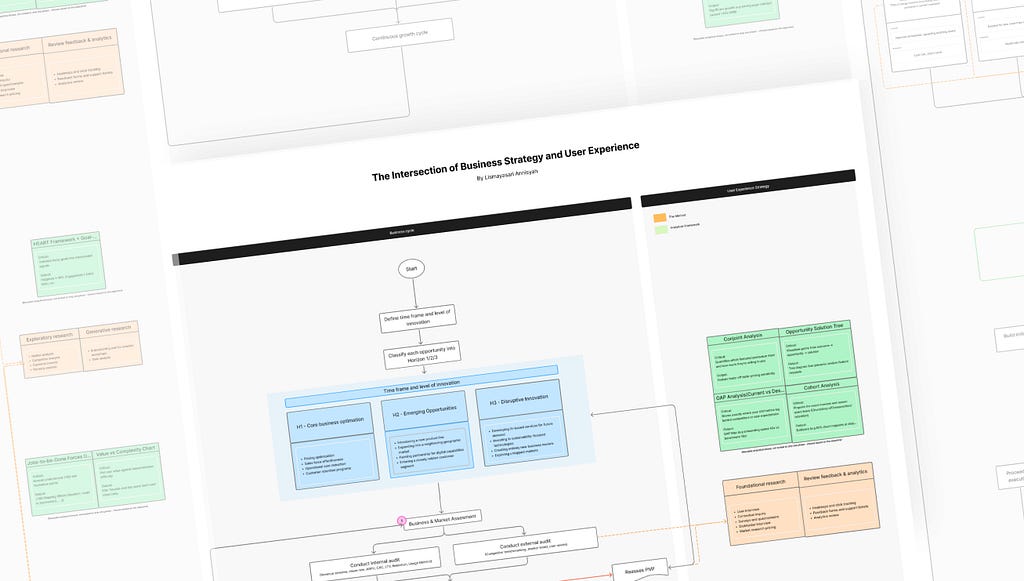
Sustainable growth = strategy × UX: ‘Build fast’ doesn’t mean rushing the final product, it’s about rapidly testing ideas with cheap prototypes and experiments. But don’t confuse this agility with a lack of strength, focus, or clear objectives; true growth demands disciplined alignment to build lasting foundations.
This article is suited for UX growth-focused professional, product people, or startups that speak the language of business, tying insights to money, time, or risk.
As a User experience growth focused, my design process is governed by a series of questions:
“Have I defined the right problem?”
“Am I getting clear insights, or is there bias?”
“How might I solve it?”
“Is this the best solution?”
“How does it work?”
“What should I measure?”
“What risks might it create? How’s the future stage or future enhancement?”
“Does it impact both the business and the users positively?”
This mindset isn’t just good UX, it’s the bedrock of sustainable growth. Too often, companies chase growth at all costs, only to discover their foundation is crumbling. They scale a product people don’t love, solve problems users don’t have, and burn resources on ineffective experiments.
Let’s take a look at Workday, it’s a powerful HR and finance platform often criticized for its frustrating user experience, especially in the job application process. You guys, who’s ever tried Workday? We might know this isn’t an isolated issue. The Baymard Institute found that nearly 70% of online shopping carts are abandoned, largely due to poor UX.
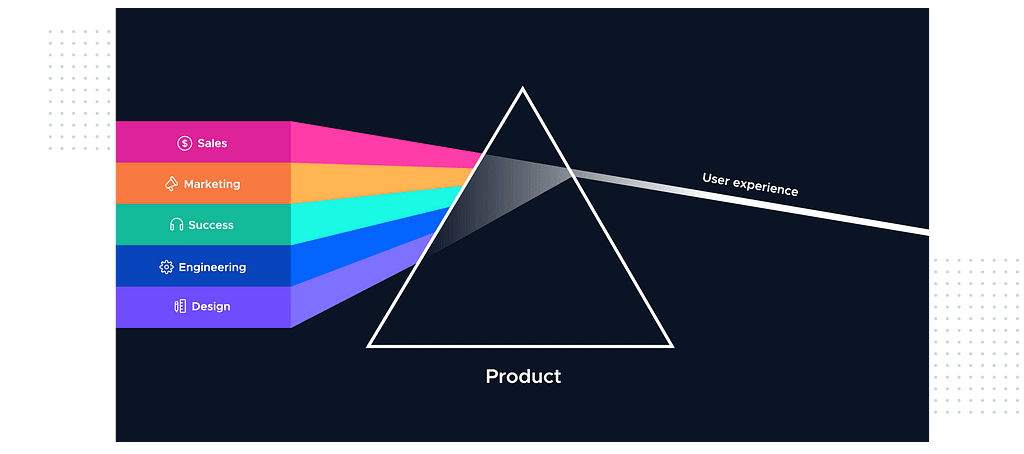
This is the exact problem Product-Led Growth (PLG) aims to solve. In simple terms, PLG means your product itself becomes the primary engine for user acquisition, conversion, and retention. It’s a philosophy that forces design, marketing, sales, and engineering to align around the user experience. Often, this activity proceeds by a growth team who orchestrates but the skeleton is strategy + user experience.
But there’s a catch.
The Foundation: Product-Market Fit
A business can only focus on true, scalable growth after achieving product-market fit. Without it, growth activities just scatter your efforts instead of driving focus, and accelerate failure.
So, how can you tell if your business has reached product–market fit?
It certainly shows up in terms of happier customers, lower churn rates, shortened sales cycles, and rapid organic growth. But the threshold for any of these can be tough to define.
For Pre-Product
- Visible excitement: “…we were getting literal love letters”
- Someone’s pupils dilate when they use your stuff
- People are wiling to pay for it now
For Post-Product
- Retention: Users stick around. There’s a group of customers who finding product value
- Surveys: Users say they’d be very disappointed if your product went away (if the percentage is over 40%)
- Exponential organic growth: Ideally more than 50% of your new accounts come from direct or organic traffic
- Cost efficient growth
- CAC < LTV
- Customer clamor for your product
- People are using it even when it’s broken as the product growing quickly
Once product/market fit is in, then there’s a level of product/market fit. To see where your product stage is, learn more in Lenny’s newsletter here
If you don’t see the signals in the right column, your only goal is to find PMF. Scaling beforehand is like building a skyscraper on sand.
The Pitfall: Confusing Speed with Strength
The pressure to grow fast, especially in early-stage startups, can be deafening. But speed without direction leads to failure.
An experienced business strategist, Yulia Neicovcean, illustrates two scenarios:
“…
Scenario 1: Growth That Lasts
Companies decided early to build structure solid CRM, client retention strategies, and a focus on prime communities. They didn’t try to do everything. They specialized. As the market shifted, their brand held strong, and they kept growing steadily instead of burning out.
Scenario 2: Failure in Fast-Forward
Another company scaled aggressively hiring quickly, chasing every new trend, ignoring compliance and fundamentals. For a year it looked like they were unstoppable. But when regulations tightened and clients demanded quality over quantity, the cracks showed. Within two years, they went from “the next big thing” to closing their doors.
The lesson is clear:
Growth is not proof of success; sustainability is. “
This is where two powerful frameworks come together to create a solution.
1. McKinsey’s Three Horizons of Growth: The Strategic Compass
The McKinsey Three Horizons model first introduced in The Alchemy of Growth (1999) remains a valuable tool for prioritizing innovation. However, its traditional interpretation has a critical blind spot in the digital age.
The original model suggests that disruptive innovations (Horizon 3) emerge from long research and development cycles. While this is still true for fields like biotech or energy, the modern trap is failing to recognize that today’s most powerful disruptions often skip this lengthy phase.
Instead, they are achieved by repurposing existing, mature technologies — like cloud computing, APIs, and mobile platforms — into radical new business models. This is where strategy and user experience intersect:
- Disruption Lies in Business Model & UX: Companies like Uber, Airbnb, and Instagram didn’t invent new core technologies (GPS, online payments, photo-sharing). They leveraged existing ones to create a fundamentally superior and seamless user experience, which in turn defined a new business model.
- Speed as a Disruptive Force: The ability to rapidly deploy these experience-driven models creates a powerful advantage. A competitor stuck in the old Horizon 3 mindset is still in R&D, while a UX-focused competitor has already captured the market.
Therefore, the framework is still useful for categorizing ambitions, but its value for planning disruption is limited. Its full potential is only unlocked when integrated with a deep understanding of how existing technology can be reimagined through user-centric design to create immediate, market-changing value.
The model guides you to balance your focus across three time horizons:
- Horizon 1 (H1): Your Core Business. This is what pays the bills today. Initiatives here focus on optimizing, defending, and growing your existing operations (e.g., improving checkout conversion rates).
- Horizon 2 (H2): Emerging Opportunities. These are new ventures that are expected to become your core business in the next 1–3 years (e.g., launching a new product line or entering a new market).
- Horizon 3 (H3): Future Bets. These are long-term ideas and experiments that could define your future (e.g., R&D for a disruptive technology).
The failed company in Scenario 2 was likely chasing H3 dreams without a profitable H1 foundation. A sustainable strategy requires actively managing all three.
2. UXR as a Product Discovery Mindset: The Reality Check
As Marty Cagan notes in his book INSPIRED, “The few that succeed are usually those that are really good at the product discovery phase.” This is where User Experience Research (UXR) evolves from a mere task into a core mindset.
It’s the continuous practice of asking:
- “Are we solving the right problem?”
- “Will users actually use this?”
- “Can we build a viable business around it?”
This UXR mindset is the solution to the “Three Horizons trap.” It replaces long, risky R&D cycles in H3 with a culture of continuous learning, ensuring strategy is guided by evidence from the very beginning.
This isn’t about occasional testing, it’s about rapidly identifying hidden opportunities to repurpose our existing technologies to solve real user problems with the right analysis. This approach enables the fast, asymmetric disruptions that define modern, sustainable growth.
This is why I created the Sustainable Growth Flowchart. It’s a practical map that combines these two frameworks, ensuring every growth initiative is grounded in both strategic business planning and user reality.
The Sustainable Growth Flowchart: The Intersection of Business Strategy and User Experience
For downloadable file: check here

Let’s walk through the key decision gates. The entire process is a cycle, governed by ‘Monitor, Measure, and Adapt.’
- Begin with a Ruthless Audit: Defining the Right Problem
The flowchart starts here because launching into solutions without validating the core problem is a fundamental failure mode in UX and product design. This step embodies a user research (UXR) mindset, systematically deconstructing assumptions through methods such as analytics review, user interviews, surveys, competitive analysis, or journey mapping. The term “ruthless” signifies a commitment to brutal honesty and a willingness to kill ideas if data reveals they are misaligned or ineffective. This audit is not a one-time event; it’s a process for uncovering latent opportunities, such as unmet user needs that could drive retention or acquisition.
I watched Melanie Perkins, Co-founder and CEO of Canva, explain in Founder Story interviews that their core mission was to “democratize design” making design accessible to non-designers rather than simply adding features to complex tools. Through user research and analytics, they refined the problem statement, which led to a simplified interface and increased adoption among users who were not design experts.
As I’m in a SaaS product, this might involve auditing my onboarding flow. If drop-off rates are high, user interviews could uncover confusing UX patterns, prompting a redesign that aligns with users’ mental models. Incorporating tools like heatmaps (e.g., Hotjar) is one of many methods that can be used to help identify cognitive biases in our assumptions, ensuring the problem is validated by users (the right problem), not ego-driven.
2. The First Critical Gate: Product-Market Fit (PMF)
This is the flowchart’s decisive checkpoint: “Have we achieved Product-Market Fit?” If not, the directive is to return to research; scaling is not permitted. PMF means your product solves a real problem for a well-defined market so effectively that users become habitual adopters. UXR verifies this by connecting to problem/solution fit, GAP analysis, value proposition clarity, Bayesian analysis, or mixed-method research. Also, see metrics like retention, churn rates, or any metrics that fit our business type. Bypassing this gate means investing resources into what the flowchart calls a “broken engine.”
I read ‘The Slack Origin Story’ by Techcrunch, they explained that Slack serves as a classic example, as it pivoted from a gaming tool to a team communication platform after internal data showed skyrocketing adoption within their own team. Early PMF was validated through strong engagement metrics and user feedback, which justified scaling efforts. Regarding this, UX people can conduct cohort analysis, if users return daily and refer others, you likely have PMF.
If not, iterate on core features using qualitative insights, bayesian analysis, the buyer’s/user journey, or any method that can map the system.
We maybe familiar with Airbnb, they achieved PMF by focusing on high-quality photos and trust-building UX elements, converting skeptical users into advocates. This gate prevents startups from burning capital on unvalidated ideas, reinforcing user experience as the foundation of market resonance.
3. Set Goals and Select Your Lever: Balancing Growth Strategies
Once PMF is confirmed, the flowchart directs you to establish measurable goals such as KPIs for user acquisition or churn reduction and choose appropriate growth levers. This draws on the Ansoff Matrix: Market Penetration (deepening engagement within existing markets), Product Development (building new features for current users), Market Development (bringing existing products to new markets), or Diversification (launching new products in new markets). It’s critical to align these with strategic time horizons: H1 (short-term optimization), H2 (medium-term expansion), and H3 (long-term innovation) ensuring sustainability without overextending resources. This means UX practitioners can recommend a lever prioritize that enhance user delight, while the company sets up strategic resource allocation.
Spotify as our favorite music player, for instance, they employed Product Development (H2) by introducing personalized playlists, which increased retention among existing users, while also pursuing Market Penetration (H1) through free-tier offerings in new regions.
For example, if we have a goal to double user growth, we might choose Market Penetration via UX improvements like a seamless referral program while investing in H3 diversification such as AI-powered features.
Quartr.com explained that Netflix successfully diversified into original content (H3) after saturating its core streaming market, using data to guide decisions. This balanced approach avoids the “growth at all costs” trap, ensuring UX drives long-term value.
4. The Alignment Check: The PLG Litmus Test
Before execution, the flowchart mandates asking: “Are cross-functional teams aligned and adequately funded?” This step operationalizes Product-Led Growth (PLG), where the product itself through intuitive UX drives acquisition, conversion, and expansion, reducing reliance on heavy sales tactics. If marketing, design, engineering, or other teams are not synchronized, the process loops back. This prevents siloed efforts that undermine initiatives. Designers need this alignment to ensure UX remains central. Also, it means funding experiments with clear ownership.
Ruben Dominguez wrote about The Rise of PLG, explaining that Dropbox mastered PLG by making file-sharing so effortless that users naturally invited others, with cross-functional teams iterating based on evidance and the right problem. Let’s check our business, If your PLG test fails, evidenced by a low viral coefficient, it may stem from misalignment. For example, researcher deliver insights and recommendations about, but marketing have different definition about the findings. Also, design may advocate for user testing, but engineering lacks the resources to implement changes.
Grammarly is another example: cross-functional alignment around a freemium UX model fueled viral growth without significant marketing spend. This can be initiated by the product, research, or growth department. This check is especially critical in startups, where limited budgets amplify the cost of misalignment.
The entire process is cyclical, governed by ‘Monitor, Measure, and Adapt, and back to monitor because sustainable growth is never a one-and-done effort.”
The entire process is cyclical, governed by ‘Monitor, Measure, and Adapt, and back to monitor because sustainable growth is never a one-and-done effort.”
As it’s never a one-and-done effort, what’s the truth about business growth?
Scaling a business and achieving exponential growth isn’t something impossible. Even though it’s difficult, it can be achieved when a business truly has the right strategy, the right execution, and the right focus.
It’s also important to understand what actually slows down business growth whether it’s the team, the system, the strategy, or even the mindset and inaccurate knowledge that shape every decision.
Oh, I know. It’s so easy to say things like, “Just check your business issues, solve them, and you’ll have sustainable growth!”
Sometimes you already have high-quality services, a brilliant system, and strategic marketing but the real issue is in our mindset or even our immaturity.
But the good news is: we can always learn, unlearn, and relearn anything.
Key reminders for designer growth focused
What I’ve learned from my own reflections and insights from product leaders:
1. Set clear goals; for the day, the week, the month, and the year.
2. Investigate deeply; look for real opportunities and make sure you’re solving the right problem.
3. Experiment and iterate; explore concepts with scalability potential or take calculated risks.
- Apply the right product design principles
- Use the right UI patterns and UX laws that work
- Read and interpret data clearly
- Choose effective methods and define the right metrics
4. Be aware of design responsibility; always consider the impact on both users and the business. Ethics matter.
Sustainable growth demands both strategic discipline and user-centered insight. Speed alone is not strength. Strength comes from clarity, reflection, and responsible execution.
My flowchart is not a final answer, but a guide a tool for reflection and decision-making. It exists to replace guesswork with a disciplined, evidence-driven system.
Now, ask yourself:
Where does your product currently stand? And what is one growth initiative you could pressure-test with this flowchart today?
If you’ve walked this path before and have a story to tell, I’d really love to hear it.
Thank you for being curious! 🌱
More details findout here
- Mckinsey Three Horizon Models by Product Mindset
- The truth about acjieving business growth by Entrepreneurs
- Growth design: The fusion of business and UX Design by Justin Gupta
- Inspired book by Marty Cagan
- What is Product Led Growth?
- How to know if you’ve got product-market fit by Lenny
- The slack origin story https://techcrunch.com/2019/05/30/the-slack-origin-story/
- The Influence of Digital Changes on Media And Entertainment Business Models: A Case Study of Netflix and Spotify
- Inside Netflix: Innovation, Originals, and Cultural Phenomena
- Adding That Extra ‘You’ to Your Discovery: Oskar Stål, Spotify Vice President of Personalization, Explains How It Works
- The Evolution of Growth Hacking in 2025
Hi, I’m Lisma, a designer-thinker who loves to help brands and the product solve the right problem and find growth opportunities for acquisition, activation, retention, and revenue | UX researcher | Ex: Marketing partner and build creative-marketing agency
Feel free to connect on Linkedin
Sustainable growth flowchart was originally published in UX Collective on Medium, where people are continuing the conversation by highlighting and responding to this story.